Many industries, including oil, petrochemicals, food, pharmaceuticals, agriculture, and even water treatment, constantly need to remove impurities, solid particles, and pollutants from liquids. The choice of filtration method directly impacts the quality of the final product, the lifespan of the equipment, and maintenance costs. Centrifugal filters are among the most common and effective methods in this field.
These filters use centrifugal force to separate solid particles, oil, water, and other contaminants from liquids. Compared to conventional filters, centrifugal filters are more efficient and require less maintenance.
What is a centrifugal filter?
A centrifugal filter is a mechanical device that separates suspended solids and impurities from a liquid through rapid rotation . In this system, the liquid enters a rapidly rotating chamber. Heavier particles are flung against the chamber walls by centrifugal force and separated from the liquid, while the purified liquid flows out.
How a centrifugal filter works
-
Contaminated liquid enters the device.
Liquid containing suspended particles flows through the inlet tube into the filter. -
The high rotational speed inside the chamber causes
the liquid to rotate at high speed. -
Due to the action of centrifugal force,
heavier liquid particles are pressed against the wall and settle out. -
The purified liquid flows out.
The lighter, particle-free liquid moves towards the center of the chamber and exits through the outlet.

Types of centrifugal filters
1. Manual filter
-
Manual drainage and sediment removal are required.
-
Suitable for use in small businesses and laboratories.
2. Self-cleaning filter
-
The sediment is automatically drained.
-
Suitable for large-scale industrial applications and continuous operation.
3. Multi-stage filters
-
It contains several centrifugal chambers for more thorough cleaning.
-
It is very effective at removing even the smallest particles.
4. Horizontal and vertical filters
-
The selection is made according to the installation plan and the available space .
Application of centrifugal filters
1. Oil and petrochemical industry
-
Separation of sand, clay and impurities from crude oil.
-
Extending the service life of pumps and process plants.
2. Water and wastewater treatment
-
Removes suspended solids, sand and gravel from the raw water.
-
Water treatment before entering the membrane filter or reverse osmosis system.
3. Food and pharmaceutical industry
-
Refined cooking oils and fruit juices .
-
Particle removal to improve product quality.
4. Agriculture and irrigation systems
-
Prevents small particles from entering pipes and nozzles.
-
Extends the lifespan of your drip irrigation system .
5. Automotive and heavy machinery manufacturing
-
Clean your engine oil and fuel to reduce wear.
-
Prevent premature failure of sensitive components.
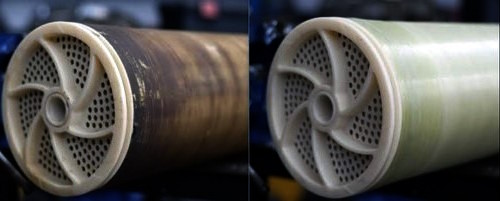
Low salt content CSM RE4040-BLR
Advantages of centrifugal filters
-
Consumables such as paper filters or filter cartridges are not needed : This reduces operating costs.
-
Continuous operation capability: suitable for large industrial plants with continuous production processes.
-
It is able to effectively remove solid particles even at high concentrations.
-
Reduce wear and tear on equipment: Prevent particles from entering pumps and supply lines.
-
Easy installation and maintenance: This is especially true for self-cleaning models.
-
Robust and durable: Made from stainless steel or corrosion-resistant alloy.
Limitations and disadvantages of centrifugal filters
-
Its effectiveness in separating very small particles (less than 5 micrometers) is limited.
-
Because a high rotational speed is required, the power consumption is relatively high.
-
The purchase costs are higher than for conventional filters.
-
Sufficient space is required for installation , especially for large industrial models.
Factors influencing the selection of centrifugal filters
-
Type of liquid and concentration of suspended solids.
-
Traffic and workload data are required.
-
Size of the removed particles.
-
Free space for installation.
-
Acquisition and maintenance costs.
-
Operating conditions (temperature, pressure and corrosive activity of the liquid).
Maintenance and repair of centrifugal filters
-
Regularly check the interior and the walls.
-
The sediments are removed periodically or automatically .
-
Lubrication and maintenance of rotating systems.
-
Check seals and bearings.
-
Cleaning of the water inlet and outlet pipes.
Proper maintenance can significantly extend the lifespan of your filters and reduce the need for costly repairs.
The future of centrifugal filters
Thanks to technological advances, future centrifugal filters are expected to have the following properties:
-
Use an intelligent monitoring system to control filtration quality.
-
Development of energy-efficient models to reduce energy consumption.
-
Alloys and corrosion protection coatings are used to extend the service life .
-
More compact and portable models are suitable for laboratory use and small-batch production.
In conclusion
Centrifugal filters are among the most common and effective filtration devices in various industries . Using centrifugal force, these filters separate impurities and solid particles from liquids, thus improving product quality and extending the service life of the equipment.
Despite their relatively high initial cost, these filters are extremely economical due to lower maintenance and operating costs. Choosing the right filter type for the specific project requirements has a significant impact on production efficiency and the quality of the final product.